'Attack Of The Killer Tomatoes' Is The Most Absurd Franchise In Movie History
What started as a student project became one of the best homicidal fruit franchises to date, mostly because of the earnest effort that went into the making of Attack of the Killer Tomatoes. It's one of the strangest, if not silliest B-movies ever produced. Originally released in 1978, the titular killer tomatoes became legendary villains of campy horror and inspired three sequels. The film came together because of the sincere efforts of the cast and crew, but the plot doesn't employ the same level of seriousness as its creators. Regardless of how you came upon the franchise, odds are you laughed while watching it, yet still wondered who was crazy enough to execute the idea in the first place. It has garnered quite the cult following, and these facts about Attack of the Killer Tomatoes might explain why.
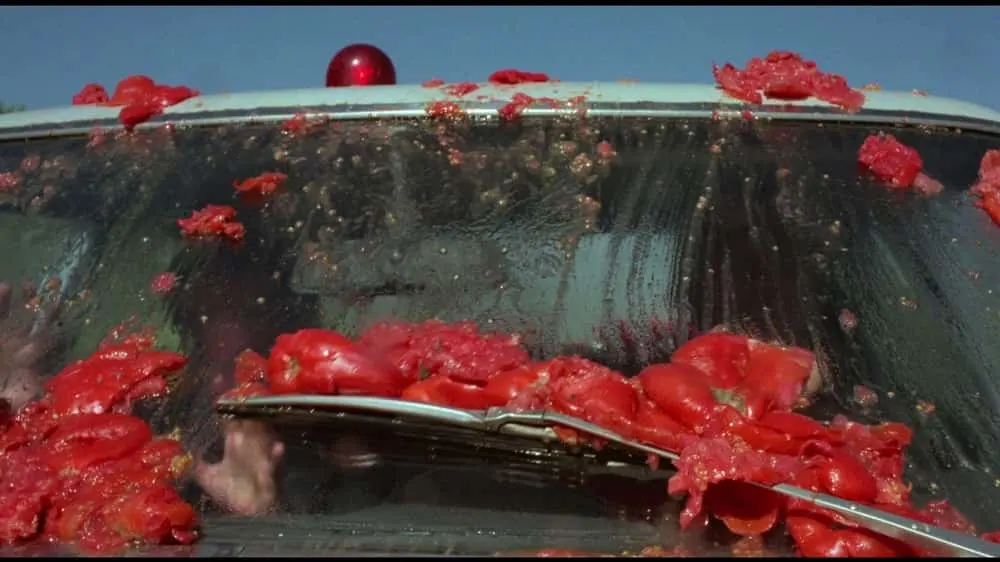
It Started Out As A Student Film
The concept for Attack of the Killer Tomatoes came from a joke creator Costa Dillon made while still in high school. A few years later, the film's production team - Dillon, John DeBello, and Steve Peace - made a 15-minute short of the killer fruit tale for a film class at UC Davis. They reportedly received an A on the project.
Dillon recalled that he watched a film called Attack of the Mushroom People and remembered thinking, "How dumb is this?" He claimed he later "got the idea that we could do something even sillier. I don't know why tomatoes came to mind first, maybe because they seemed so innocuous."
The original footage has been lost to history, but in 1978, the movie made it to theaters as a feature-length film. Dillon detailed the challenges of producing a B-movie:
We lost our shirts in distribution. We didn't pay our bills. And we learned later that we were doing things totally against the standard operating procedure of low-budget films. You're supposed to raise a lot of money, pay yourself a huge portion of it, and then make a movie with whatever was leftover. Our problem was that we wanted to have a movie we liked.
Critics Thought It Was Terrible, And The Director Agreed
When Attack of the Killer Tomatoes was released, it was selected to appear in the World's Worst Film Festival. Instead of defending their work, DeBello agreed to allow the movie to be featured under the condition that it secure the award for "Worst Vegetable Film." He contends that it was an admittedly niche category, but even so, it's impressive that a film about killer fruit won the title "Worst Vegetable Film."
In fact, the sheer absurdity of Attack of the Killer Tomatoes was so incredible that more notable media took notice. The Wall Street Journal featured the movie's poster on its front page, and it continues to make puns using the title, with articles like "Attack of the Killer Audis" and "Attack of the Killer Cappuccino." And the CBS Evening News once played the Killer Tomatoes theme song over its closing credits.
The Sequel Features A Young George Clooney
George Clooney is a notable name in Hollywood, but back in 1988, his movie career was just beginning. Return of the Killer Tomatoes marked his first lead role in a feature film, and he stole the show. The mullet-sporting 26-year-old Clooney played Matt Stevens, a suave ladies' man who battles the villainous Professor Gangrene.
Clooney's role is to prevent Gangrene from re-inciting the conflict between man and tomato by creating a race of tomatoes that can take on human form. Most of Clooney's performance is spent mocking the production by breaking the fourth wall.
That Helicopter Crash Was An Accident
The infamous helicopter crash in Attack of the Killer Tomatoes, although very real, took no lives. The unplanned event even made the final cut. The helicopter was rented for the production and is worth an estimated $60,000. When it was supposed to land, the tail rotor struck the ground causing the vehicle to spin out of control.
The helicopter rolled over and burst into flames, as seen in the movie. DeBello describes the ordeal saying:
By the grace of God, two things happened. One, the actors were unhurt, and two, one of the cameramen had the presence of mind to keep the camera rolling. I used to love this moment watching it in the theater - you're watching this schlocky-on-purpose movie, and all of a sudden 10 minutes in, there's this spectacular helicopter crash. This was the age before digital, audiences didn't just yawn. For years, people used to ask if that was real.
'The Muppet Babies' Helped The First Sequel Get Made
The filmmakers did not plan on turning Attack of the Killer Tomatoes into a franchise. One of the reasons they decided to expand with Return of the Killer Tomatoes was The Muppet Babies. The children's cartoon refers to the original film in an episode called "The Weirdo Zone." It was a huge hit, and New World Pictures offered to pay for a killer tomato sequel.
The success of the sequel, Return of the Killer Tomatoes, and the animated series, Attack of the Killer Tomatoes, inspired a couple more films. Thus, the franchise was born - all thanks to a comment from a young, animated Fozzie Bear.
It's A Parody Of The Campy Horror Genre
It may come as a surprise that this film is not to be taken seriously. It was created to satirize the campy B-movies of the 1950s and '60s. The inspiration came from absurd features, such as Attack of the Mushroom People, The Crawling Eye, and The Blob.
Producer Stephen Peace describes the film as someone asking, "What if you did a Japanese horror film that was a comedy musical that was really at its core sort of commenting upon the difficulty the modern bureaucracy has of dealing with big problems and disasters?"
The late 1970s was the perfect time for campy horror satires, seeing as both The Kentucky Fried Movie and Airplane! were respectively released just before and shortly after Attack of the Killer Tomatoes.
One Of The Filmmakers Became A Politician
Stephen Peace worked as a producer and writer for the original film. He also plays Wilbur Finletter in three of the four movies. Peace also wrote and acted in the 1987 film Happy Hour, but ultimately chose to pursue a career in politics.
The actor-turned-politician served in the California State Assembly from 1982 until 1992. In 1992, he won a seat in the California Senate, which he held until 2003. He once advocated for legislation that required food sellers to label their produce as vine-picked or artificial.
It Inspired An Animated Series And A Children's Book
For a film with a mere $100,00 budget that features rotten fruit as its main villain, it managed to wrangle a dedicated cult following. The first sequel, Return of the Killer Tomatoes, was released 10 years later in 1988. The infamous franchise proliferated with the release of Killer Tomatoes Strike Back! (1990) and Killer Tomatoes Eat France (1991). The animated series Attack of the Killer Tomatoes ran on the Fox Kids network from 1990 to 1991 and totaled 21 episodes. And a companion children's book called Attack of the Killer Potatoes was even published in 1997.
When John Astin, who plays Professor Gangreen in Return of the Killer Tomatoes, asked DeBello if he should watch the original film before joining the cast of the sequel, DeBello said, "Don't bother. There’s a lot of publicity about it being the world’s worst movie. Well, it really is."
The 'Killer Tomato' Franchise Was Breaking The Fourth Wall Before 'Deadpool'
Return of the Killer Tomatoes often makes fun of itself by breaking the fourth wall. At one point, the actors are temporarily dismayed when the crew runs out of money halfway through filming. To combat this problem, George Clooney's Matt Stevens suggests they try some "product placement," which was still an emerging practice in both film and television.
The characters gladly embrace the challenge and advertise various products throughout the remainder of the film. A few items are even directly showcased to the camera.
The Set Had Its Fair Share Of Injuries
The helicopter crash may not have resulted in serious injury, but that doesn't mean the production of the first film progressed altogether smoothly. Stephen Peace was knocked out while rehearsing a scene involving a car stunt. Lead actor David Miller recalls the accident:
There's one scene where I drag Peace around with his parachute stuck in my car door. We were in a residential area, and he was laying on some kind of a board with wheels on it. They said let's do a practice run and had someone else driving the car. They were dragging him along, go around a curve, and he flanged out, into a parked truck. He went under and hit his head on the axle, and I turn to John and say, "I think he's dead."
Peace was knocked out, but his first words when he woke up were, "Did we get that on film?" The answer was no, so naturally, he responded with, "Damn, well move the truck and let's do it again."
Matt Cameron Is Responsible For The Finale Song, "Puberty Love"
For the final battle, the cast of Killer Tomatoes knew they had to take drastic measures. In the film, the town's saving grace is the song "Puberty Love," which was performed by the filmmaker's 14-year-old neighbor. And while you might think the kid responsible for that grating musical nightmare would be hopeless in the music industry, you'd be wrong.
That 14-year-old boy was none other than Matt Cameron, the drummer for Pearl Jam and Soundgarden. Cameron comments on his part in taking down the first round of killer tomatoes:
They (Cameron's neighbors/Killer Tomato producers) knew that I was a musician, so they asked if I knew how to sing. I sort of knew how to sing, but I wasn't that good. I think that was part of the charm of the song. It sounds like a pre-pubescent voice that is cracking and can't sing that well. So I fit perfectly for the role.
The concept of using music to defeat the movie's villain was also used two decades later for Tim Burton's Mars Attacks!
The Theme Song Was Once Played In Space
John DeBello wrote a theme song for the film, which essentially describes the events of the movie by beginning with the story of a man named Herman Farbage who was eliminated while taking out the garbage. It then goes on, in a narrative yet musical manner, to tell of the passing of the narrator's sister and the tomatoes' defeating the National Guard.
NASA’s Columbia Space Shuttle crew was once woken up with the infamous song since they had been asked to recover 12.5 million tomato seeds that were sent to space in 1984.
The Franchise Isn't Limited To Film
Attack of the Killer Tomatoes isn't limited to just four movies and an animated series. In addition to the spinoff book, Attack of the Killer Potatoes, there have been two video game adaptations, made for the Nintendo Entertainment System and Game Boy, and a comic book series from Viper Comics. It even inspired Kim Harrison's book series The Hollows, which features a world where genetically engineered tomatoes take out much of the human population.
There was also a popular toy line made by Mattel. The toys resembled tomato-based characters from the cartoon, and each one came with a small figure who stands in terror beside the toy produce.
Most Of The Filming Took Place At The University Of San Diego
Almost the entire film was shot at the University of San Diego. Most of it takes place in the main parking lots and administrative buildings. Thanks to the incredibly small budget, more than a few lab coats were "borrowed" from some of the less secure offices on campus.
Dillon recalls that they "rented the San Diego Stadium for the entire day for $200, and just spent the whole day smashing tomatoes."
Another Sequel May Be On The Way
Stephen Peace and Costa Dillon announced they were working on a new sequel at San Diego Comic-Con 2018. "Seeds of Destruction" packets were hidden around the event, promoting the franchise and offering a chance to audition for a role in the new film.
Anyone interested in taking part in the sequel can register on the Killer Tomato website.